Views: 4 Author: Site Editor Publish Time: 2026-11-12 Origin: Site


Rodless cylinder is a pneumatic actuator that achieves linear motion by eliminating the traditional piston rod.
"Rodless" does not mean there is no piston, but rather that there is no piston rod extending out of the cylinder.
This arrangement offers several practical benefits:
More compact installation in the direction of travel.
Long stroke capability without requiring an equally long external rod extension.
Convenient mounting of loads, fixtures, and workpieces on the external carriage.
Flexible integration into automated transfer and positioning systems.
Rodless cylinders are commonly used in packaging equipment, material handling systems, automated assembly lines, and other industrial machinery.
Rodless cylinder: An internal piston moves within the cylinder barrel, while an external carriage (or slider) follows the piston's movement via a mechanical or magnetic coupling mechanism.
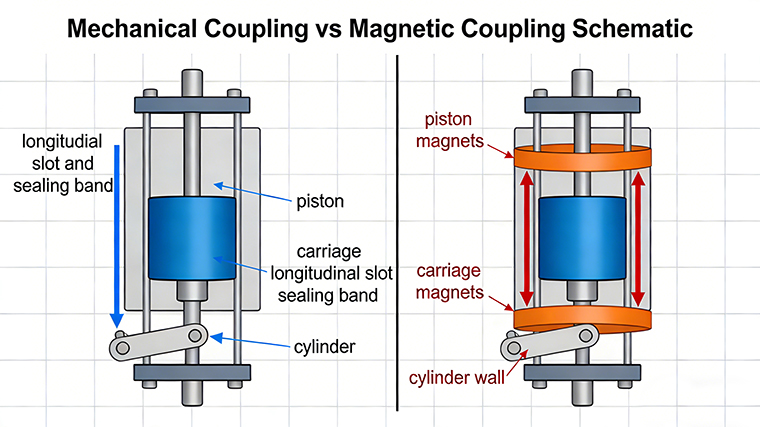
Rodless cylinders do not rely on piston rods to transmit force; instead, they rely on two sets of magnetic rings that are "attracted" together through the cylinder wall: the magnetic ring on the piston inside the cylinder and the magnetic ring on the slider outside the cylinder attract each other through the cylinder wall. When compressed air drives the piston to move, the magnetic force simultaneously drags the external slider, and the load is loaded on the slider to complete the transfer.
Because there is no piston rod extending outside the cylinder, the cylinder body can be completely sealed, preventing dust or cutting fluids from entering the piston chamber. Furthermore, the overall axial length is reduced to approximately the length of the stroke itself.
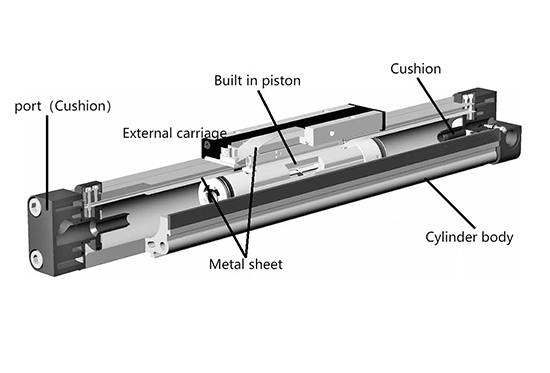
Depending on the transmission structure, rodless cylinders are generally divided into two main types: magnetically coupled rodless cylinders and mechanically coupled rodless cylinders.
A magnetic rodless cylinder uses magnetic force to connect the internal piston with an external slider.
The internal piston contains permanent magnets. The external slider also contains magnets that attract the internal piston through the cylinder tube wall. When compressed air drives the internal piston forward or backward, the magnetic coupling transfers this movement to the external slider.
Because there is no mechanical opening along the cylinder barrel, the cylinder maintains a relatively enclosed structure.
Main characteristics:
No external piston rod is required.
The cylinder has a compact structure.
There is no mechanical slot running along the barrel.
Suitable for applications requiring clean and space-saving linear movement.
The available transmission force depends on the magnetic coupling design and operating conditions.
A mechanically coupled rodless cylinder transfers the internal piston's movement to an external carriage through a mechanical connection.
A longitudinal slot is designed along the cylinder barrel. The internal piston connects to the external carriage through this slot, while sealing components help prevent air leakage. As the piston moves, the mechanical connection drives the external carriage along the cylinder.
Main characteristics:
Direct mechanical connection between the piston and carriage.
Suitable for applications requiring higher load capacity, depending on the model.
Can be designed with external guides for improved load support.
Requires attention to sealing, lubrication, and maintenance.


| Comparison items | Magnetically coupled rodless cylinder | Mechanically coupled rodless cylinder |
| Transmission method | Non-contact magnetic coupling between internal and external magnetic rings | Features a slotted cylinder barrel; the piston is mechanically connected to an external carriage. |
| Sealing structure | Enclosed cylinder barrel design; no external leakage | A sealing strip covers the slot in the cylinder barrel, resulting in a minor amount of leakage. |
| Load capacity | Limited by magnetic holding force—typically ≤10–30 kg (varies by bore size and stroke; refer to product specifications for exact values) | Provides a rigid mechanical connection, typically offering a higher load capacity than magnetically coupled versions. |
| Applicable speed | Moderate speed—typically <500 mm/s (specific limits vary based on bore size and load) | Capable of high-speed operation. |
| Cleanliness | No external leakage; suitable for cleanroom environments | Due to minor leakage, it is not suitable for environments with strict cleanliness requirements. |
| Guiding accuracy | Requires an external guide rail for guidance | Can incorporate an integrated guide rail or be used with an external guide rail. |
| Cost | Relatively low | Features a more complex structure and is relatively higher in cost. |
| Typical applications | Light-load handling, cleanroom applications, food packaging | Suitable for heavy-load handling, precision positioning, and long-stroke transport. |
* Magnetically coupled rodless cylinders utilize a sealed design to ensure cleanliness and lower costs.
* Mechanically coupled versions employ a rigid connection to achieve higher load capacity and greater precision.
* Prioritize selection based on the core constraints of the specific operating conditions—namely cleanliness requirements, load capacity, and guidance precision.
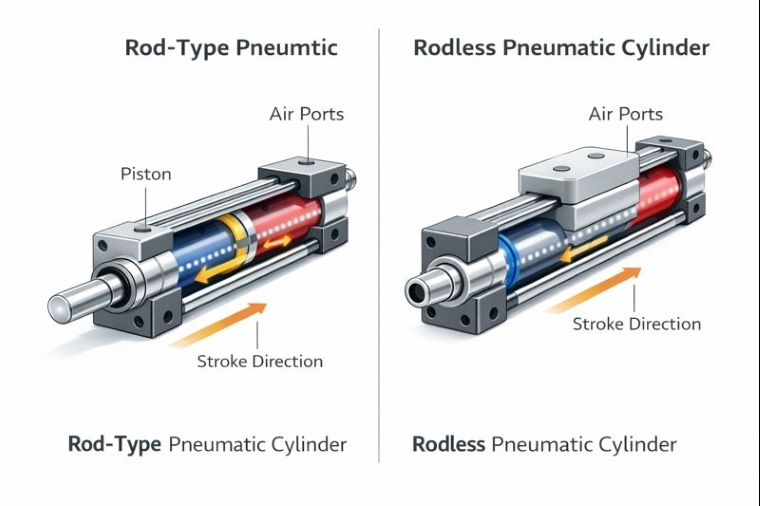
A standard pneumatic cylinder extends its piston rod beyond the cylinder body. Therefore, the installation space must account for both the cylinder length and the rod extension.
A rodless cylinder moves its external carriage along the cylinder body. This can reduce the overall installation footprint, particularly in long-stroke applications.
Comparison | Rodless Cylinder | Standard Pneumatic Cylinder |
| Piston rod | No externally extending rod | External piston rod |
| Installation space | More compact along the stroke direction | Requires space for rod extension |
| Long-stroke applications | Often advantageous | May require more installation space |
| Load mounting | External carriage | Piston rod end |
| Side-load resistance | Depends on guide structure | Depends on rod and guide arrangement |
| Installation | Requires suitable mounting and alignment | Generally straightforward |
| Typical applications | Long-distance transfer and positioning | Pushing, clamping, lifting, and general linear motion |
Important: A rodless cylinder does not automatically provide better load guidance. If the application involves significant side loads or overturning moments, an appropriate guide mechanism must be selected.
① Space-saving design
Without a conventional external piston rod, a rodless cylinder can reduce the installation space required for long-stroke movement.
② Long-stroke capability
Rodless cylinders are suitable for applications requiring extended linear travel without an equally long rod extension space.
③ Flexible equipment layout
The external carriage can be used to transfer workpieces, fixtures, or other components along a defined linear path.
④ Suitable for automated material handling
Rodless cylinders are commonly used in transfer mechanisms, loading and unloading systems, and automated production equipment.
① Load capacity must be checked
For magnetic rodless cylinders, the magnetic coupling force limits the load that can be transferred. Exceeding the specified capacity may cause the external slider to separate from the internal piston.
② Installation accuracy matters
Incorrect alignment, excessive side loading, or unsuitable mounting conditions can affect movement and service life.
③ Application conditions affect performance
Operating pressure, speed, load, stroke, and external forces must all be considered during selection.
Step 1: Confirm the Required Stroke: Determine the actual travel distance required for the equipment, while ensuring sufficient space is reserved for installation, connections, and the positioning of end-of-stroke locations.
The theoretical pneumatic force can be estimated using:
F = P × A
* F = Theoretical force (N) / P = Operating pressure (Pa) / A = Effective piston area (m²)
For a circular piston:
A = π × D² / 4
* D is the piston bore diameter.
This calculation gives the theoretical pneumatic force. It does not represent the actual allowable external load of a magnetic rodless cylinder.
For magnetic models, the allowable load must also be checked against the manufacturer's magnetic coupling specifications. Friction, acceleration, mounting conditions, and external forces should also be considered.
The load applied to the external carriage is an important selection factor. Check:
Workpiece weight
Load position
Center of gravity
Acceleration and deceleration
Lateral forces
Allowable bending moments
For applications involving significant side loads or offset loads, select a model with a suitable guide structure or use an appropriate external guide system.
Consider the following operating conditions:
Operating temperature
Working pressure
Air cleanliness
Humidity and contamination
Installation orientation
Required maintenance conditions
Always compare the actual operating environment with the manufacturer's specifications.
Electronics and Semiconductor Cleanroom Production Lines
For the transfer of wafers and PCB boards; in cleanroom environments where oil or gas leakage is strictly prohibited, the fully sealed, magnetically coupled structure offers an ideal solution.
Food and Pharmaceutical Packaging
Used in pharmaceutical sorting, bag opening, and filling stations; features a food-grade, dust-proof design that ensures no oil contamination reaches the materials.
Long-Distance Transfer in Automated Equipment
Applied in sliding door mechanisms, material handling forks for automated storage and retrieval systems (AS/RS), reciprocating spray-coating systems, and long-stroke movement within compact enclosures.
Printing and Lithium-Ion Battery Manufacturing
Used for battery cell handling, reciprocating motion in screen printing, and long-stroke scanning for vision-based inspection systems, ensuring smooth, vibration-free operation.
Small-Scale Precision Tooling
Utilized in dispensing modules, motion systems for laser marking, and reciprocating movements for inspection jigs and fixtures.


Installation tips
Check that the mounting surface is flat and properly aligned.
Make sure the cylinder is securely fixed to the equipment frame.
Avoid applying excessive side loads or bending moments to the carriage.
Confirm that the connected load moves freely without interference.
Use compressed air that meets the manufacturer's filtration requirements.
Check all air connections for leakage before operation.
Maintenance tips
Regularly inspect the cylinder body and external carriage.
Keep the moving area free from dust and foreign objects.
Check for abnormal noise, vibration, or changes in movement.
Inspect air connections and seals for leakage.
Monitor operating pressure and air quality.
Follow the manufacturer's maintenance instructions.
| Problem | Possible Cause | Recommended Check |
| Carriage does not move | Insufficient air pressure or blocked air supply | Check the air supply and pressure |
| Unstable movement | Uneven load, friction, or poor alignment | Check mounting and load conditions |
| Slow movement | Insufficient air flow or excessive load | Check air flow and actual load |
| Air leakage | Loose connections or damaged seals | Inspect fittings and sealing components |
| Magnetic decoupling | Load exceeds coupling capacity or abnormal resistance | Check load, alignment, and coupling capacity |
| Abnormal noise | Loose mounting or mechanical interference | Inspect fasteners and moving components |
* The causes listed above are common troubleshooting directions, not a substitute for checking the specific cylinder structure and manufacturer's instructions.
Yes. The rodless design simply means there is no extended piston rod; there is still a piston inside the cylinder, but the motion is transmitted to the slider outside the cylinder by magnetic force.
A standard pneumatic cylinder uses an external piston rod to transfer motion. A rodless cylinder transfers the internal piston's movement to an external carriage, allowing linear travel without a conventional extending piston rod.
A magnetic rodless cylinder uses magnetic force to connect the internal piston with an external slider. When compressed air moves the internal piston, the external slider follows the movement through magnetic coupling.
A magnetic rodless cylinder transfers motion through magnetic force, while a mechanically coupled rodless cylinder uses a mechanical connection through a slot in the cylinder barrel.
Yes. Rodless cylinders are commonly used in long-stroke linear transfer applications because they do not require the same external rod extension space as standard cylinders. The available stroke depends on the specific model.
The allowable load depends on the magnetic coupling force, bore size, operating pressure, speed, acceleration, and load position. Always check the manufacturer's specifications before selecting a model.
Lubrication requirements depend on the cylinder design. For the VPC CY1 series, the product specifications indicate that additional lubrication is not required.
Check the required stroke, load, operating pressure, speed, acceleration, installation dimensions, working environment, and mounting requirements. For magnetic models, the magnetic coupling capacity must also be verified.



 English