



 English


A pneumatic vacuum ejector that is not performing does not always mean you need a replacement. Most vacuum generator problems in pick-and-place systems, such as inconsistent suction, slow evacuation, dropped parts, or excessive noise, are setup or maintenance issues you can diagnose and fix without replacing the ejector. This guide covers the 8 most common vacuum ejector failures, featuring practical troubleshooting steps verified against SMC ZH-series and Schmalz vacuum system design data.
Before you swap the ejector, work through these 8 problems in order. Each section includes a quick diagnosis step, a real fix, and a quote from our application engineers drawn from hundreds of pick-and-place commissioning visits. Most cases are resolved in under 15 minutes per station.
Key terms used in this guide: pneumatic vacuum ejector (the Venturi-based generator that creates suction from compressed air), vacuum pad (the suction cup at the end of the tube), S-type (suction / high-vacuum) and L-type (large flow) ejector variants.
1. Vacuum Ejector Picking Up Inconsistently — Sometimes Works, Sometimes Doesn't
Most common in: packaging lines, electronics assembly, robotic pick-and-place cells.
 Figure 1.1: Pressure fluctuations caused by shared air header — the same supply feeds multiple actuators, and the vacuum generator sees a pressure dip every time a cylinder fires.
Root cause: The vacuum generator is sharing a single air header with other actuators. Every time a downstream cylinder strokes, it draws 30-50 L/min from the same supply. The header pressure dips, the Venturi nozzle sees lower differential pressure, and vacuum level drops by 5-15 kPa for 100-300 ms — long enough to drop a workpiece in mid-stroke.
Diagnose it: Install a 0-1.0 MPa pressure gauge directly at the vacuum ejector inlet (not at the FRL outlet). Run the machine through a full cycle with cylinders actuating. If you see pressure swing more than 0.05 MPa, the supply is unstable.
Expert Annotation: A pneumatic vacuum ejector performs best at 0.45 MPa supply pressure. Above 0.5 MPa, a supersonic shock wave forms inside the nozzle, which actually reduces vacuum performance. Below 0.4 MPa, suction flow collapses. The "sweet spot" is narrow: 0.35-0.6 MPa, optimal at 0.45 MPa.
Fix it (in this order):
① Branch the vacuum generator off a dedicated 8 mm OD line, separate from cylinder and blow-off supplies.
② Add a 2-5 L accumulator tank at the ejector inlet to buffer pressure transients.
③ Verify that the FRL is sized for the total plant air consumption, not just the ejector.
④ Set the regulator to 0.45 MPa and lock it.
2. Vacuum Builds Initially, Then Slowly Drops
Most common in: dusty or oil-mist-heavy environments (stamping, machining, foundry).
 Figure 2.1: Silencer back pressure — a clogged exhaust element creates reverse pressure that slowly bleeds vacuum back to atmospheric.
Root cause: The exhaust silencer is partially clogged with oil mist and dust. A Venturi vacuum generator works by accelerating air through a nozzle and exhausting it out the back. If the exhaust path is restricted, back pressure builds up inside the generator body, slowly equalizing the vacuum to atmospheric. The workpiece holds for 1-2 seconds, then drops.
Diagnose it: Remove the silencer. Run the ejector. If vacuum holds steady without the silencer, the silencer is the problem. You can also weigh the silencer — a saturated one is noticeably heavier from absorbed oil.
Fix it:
Clean the silencer element in a parts-washer solvent bath, then blow dry with filtered air. Most elements recover 80-90% of flow.
Replace the silencer every 3-6 months in dusty environments; every 12 months in clean rooms.
Switch to an open-type exhaust with a remote exhaust line (10 mm hose routed outside the cabinet). This eliminates the silencer restriction entirely.
Install a coalescing filter upstream to remove oil mist before it reaches the ejector.
Expert Annotation: Box-type vacuum ejectors with built-in silencers are quieter but require more frequent silencer service. If your cycle time is short (under 2 seconds) and the cabinet is dusty, an in-line ejector with a remote silencer is more reliable long-term.
3. Evacuation Takes Too Long — But the Ejector Is Sized Correctly
Most common in: multi-station lines with centralized vacuum and long tubing runs.
 Figure 3.1: Tubing length vs time to 95% vacuum. Doubling the tube length more than doubles the evacuation time because volume scales with length.
Root cause: The tubing between the ejector and the pad is too long, too large in inner diameter, or both. Air has to be evacuated from the entire pipe volume before the pad sees full vacuum. Most operators blame the ejector, but a 0.7 mm nozzle with a 3 m tube takes 2.5 seconds to reach 95% vacuum — and most pick-and-place cycles target under 1.5 seconds.
Use the piping volume formula:
T2 ≈ 3 × (V × 60) / Q
Where T2 = time to 95% vacuum (s), V = tubing + pad volume (L), Q = ejector suction flow (L/min).
Worked example: 0.7 mm nozzle, Ø40 mm pad (cup volume 5 mL), 3 m of 6 mm ID tubing.
Tube volume: π × (0.003)² × 3 = 0.085 L
Pad volume: 0.005 L
Total V = 0.09 L; suction flow Q = 26 L/min
T2 ≈ 3 × (0.09 × 60) / 26 = 0.62 s to 95% vacuum
Push that to 5 m of tube and T2 jumps to 1.04 s. Switch to a 0.5 mm ID tube and the same 3 m drops back to 0.25 s.
Expert Annotation: "6 mm ID tubing" on a hose supplier's spec sheet usually means 8 mm OD heavy-duty polyurethane. True 6 mm ID requires 10 mm OD. Always measure the inside diameter with calipers when troubleshooting slow evacuation — most "6 mm" hoses on shop floors are actually 4 mm ID.
Fix it (in this order):
① Move the ejector as close to the pad as physically possible (under 500 mm is ideal).
② Use smaller inner-diameter tubing — 4 mm ID is often faster than 6 mm despite the higher flow resistance.
③ Step up to a larger nozzle (1.0 mm or 1.5 mm) to increase suction flow Q.
④ If you cannot move the ejector closer, switch to a decentralized architecture (see Problem 7).
4. Parts Drop During Fast Robot Moves — Yet the Gauge Shows -80 kPa
Most common in: high-speed robotic pick-and-place, Delta robots, 6-axis arms running over 1 m/s.
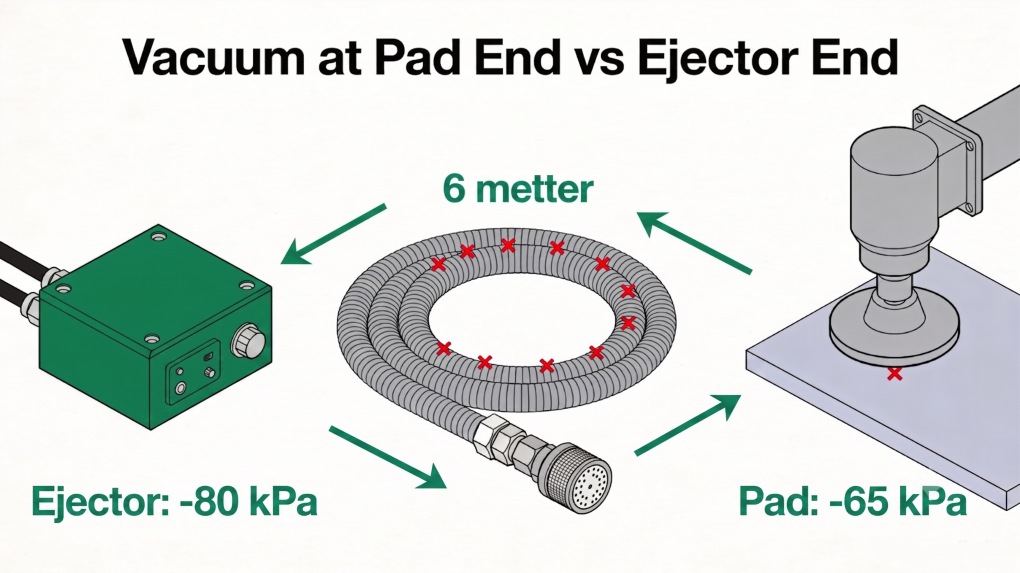
Root cause: Your vacuum gauge is mounted at the ejector, not at the pad. Flow resistance in the tube, fittings, and inline filter typically costs 10-20 kPa. The pad only sees -60 to -70 kPa — borderline for a thin steel sheet under 2 g acceleration.
Diagnose it: Connect a second vacuum gauge (or a T-fitting with two gauges) at the pad itself. Compare readings at rest and during a fast horizontal move. The pressure difference reveals your real head loss.
Expert Annotation: A vacuum pressure switch mounted at the ejector tells you the ejector is healthy. A vacuum pressure switch mounted at the pad tells you the workpiece is held. They are not the same problem. Always use pad-end sensing for production-critical pick-and-place.
Fix it:
Mount the vacuum pressure switch at the pad (or as close to it as possible). One per pad for critical applications, or one per group of 4 pads for cost-sensitive lines.
Replace 6 mm ID tubes with 4 mm ID for short runs (under 1 m) to reduce internal volume and lag.
Eliminate inline filters in the vacuum line. Filters belong on the compressed air supply, not between ejector and pad.
Use quick-disconnect fittings with the largest possible bore (5 mm+); restrictive QD fittings are a common hidden pressure-drop source.
5. Porous Workpieces (Cardboard, Foam, Wood) Fail to Reach Vacuum Setpoint
Most common in: packaging lines, woodworking, textile handling, foam cutting.
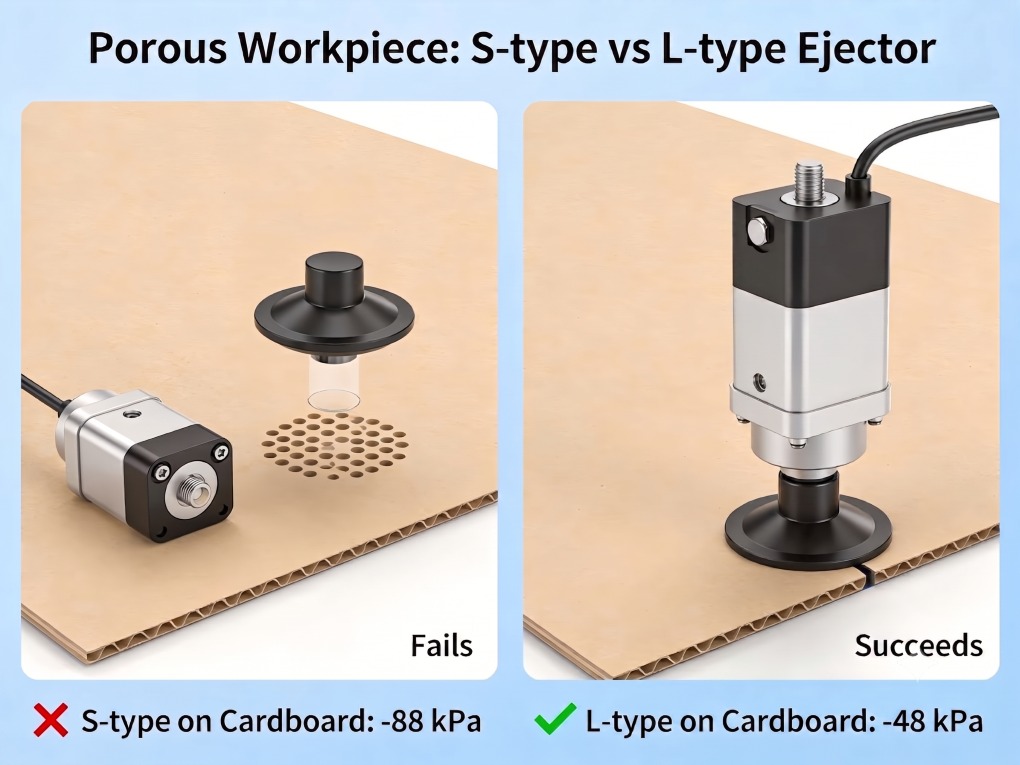
Root cause: Continuous air leakage through the workpiece. With a porous material, you are not fighting a sealed system — you are fighting a controlled leak. The vacuum level settles where leak flow equals suction flow. A high-vacuum S-type ejector produces strong peak vacuum but low flow, so it loses the race against the leak.
Quick test: Place the same pad on a sheet of glass versus a sheet of cardboard. If the S-type stabilizes at -60 kPa on cardboard but -85 kPa on glass, the leak rate is your bottleneck. Switch to L-type.
Counter-intuitive fix: Choose the L-type (large flow) ejector, not a higher-vacuum model. A 1.5 mm L-type nozzle on a porous cardboard box can hold -60 kPa where a 0.5 mm S-type only manages -45 kPa — even though the L-type has a lower theoretical maximum vacuum.
Expert Annotation: The S-type vs L-type decision is not about workpiece weight — it is about leakage rate. Sealed metal or glass: S-type. Cardboard, foam, wood, fabric, paper: L-type. The wrong choice costs you 30-50% of your cycle time on every pick.
Fix it:
① Identify the workpiece porosity. Cardboard, foam, particle board, fabric, and paper all need L-type.
② Use soft, conforming pads (silicone or urethane, Shore A 30-50) that seal against surface irregularities.
③ Increase pad area: two 20 mm pads can outperform one 30 mm pad on porous surfaces because they distribute the load.
④ If the leak is extreme, consider a bellows pad with internal support ribs.
6. The Pneumatic Vacuum Ejector Is Too Loud — Operator Complaints
Most common in: workstations within 2 m of operators, assembly cells, packaging tables.
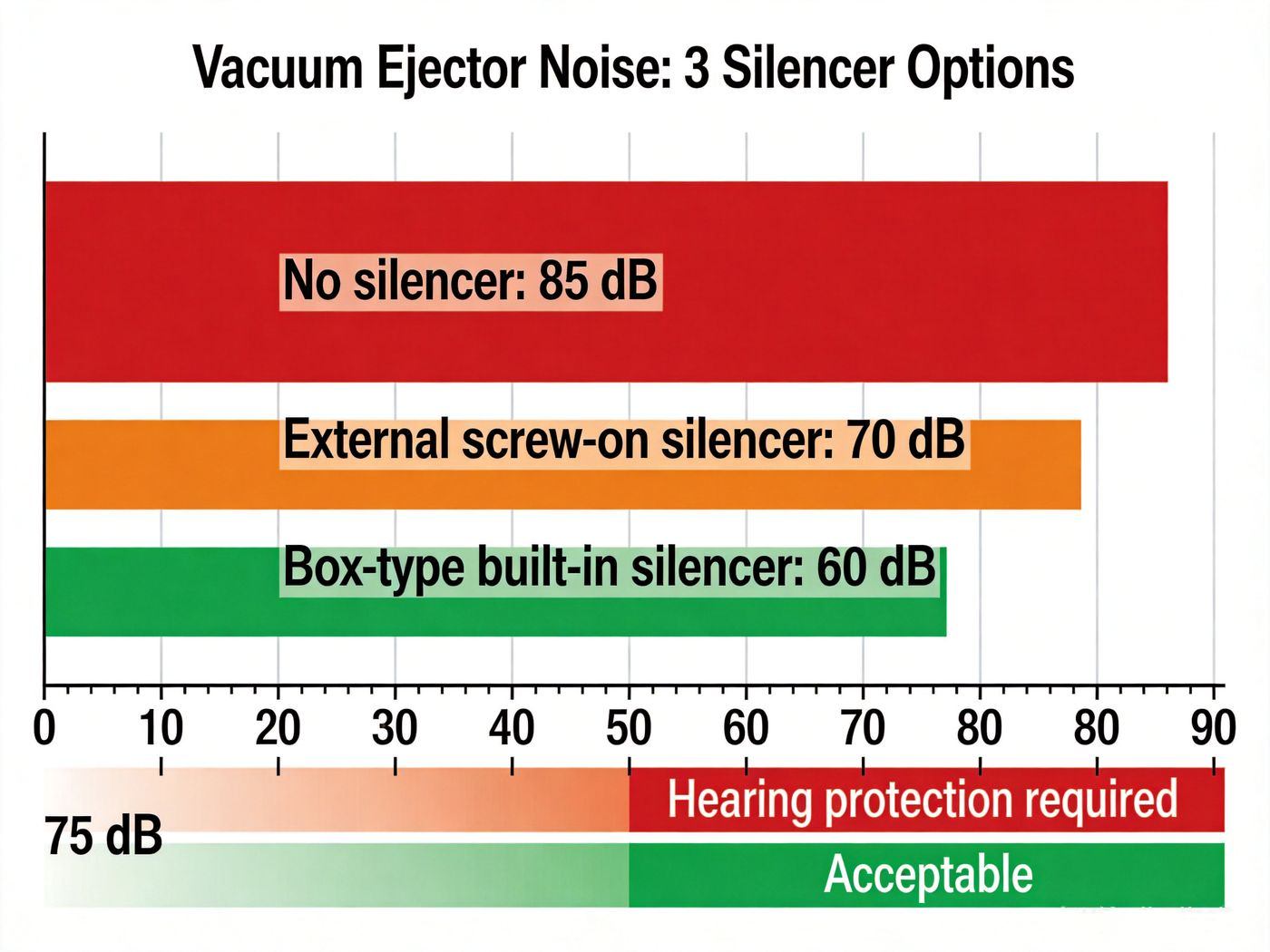
Root cause: A bare Venturi exhaust port generates a high-frequency whistle in the 75-85 dB(A) range. Without silencers, a single station running 60 cycles per minute creates a constant noise exposure that crosses OSHA's hearing protection threshold (85 dB 8-hour TWA).
Diagnose it: Stand 1 m from the ejector and measure with a sound meter or smartphone app. Anything above 80 dB needs attention.
Expert Annotation: Adding a silencer always costs you 2-5% of vacuum flow because the silencer is itself a flow restriction. For most pick-and-place applications this is acceptable. For high-flow L-type ejectors, oversize the silencer to maintain flow.
Fix it (by noise target):
Target under 65 dB (recommended): Switch to a box-type ejector with built-in silencer. Best choice for operator-facing stations. Cost premium of 30-50% over body-ported.
Target 65-75 dB (acceptable): Add an external screw-on silencer to a body-ported ejector. Cheapest option, easy retrofit.
Target above 80 dB (hearing protection required): Leave the silencer off only if the operator is more than 3 m away or wears hearing PPE.
Best practice for cabinets: Route the exhaust through a 10 mm hose to a remote silencer mounted outside the work envelope.
7. 20 Pads on One Ejector — Evacuation Takes Forever
Most common in: large-area handling, multi-pad EOAT, glass-panel lifting, large carton pick-and-place.
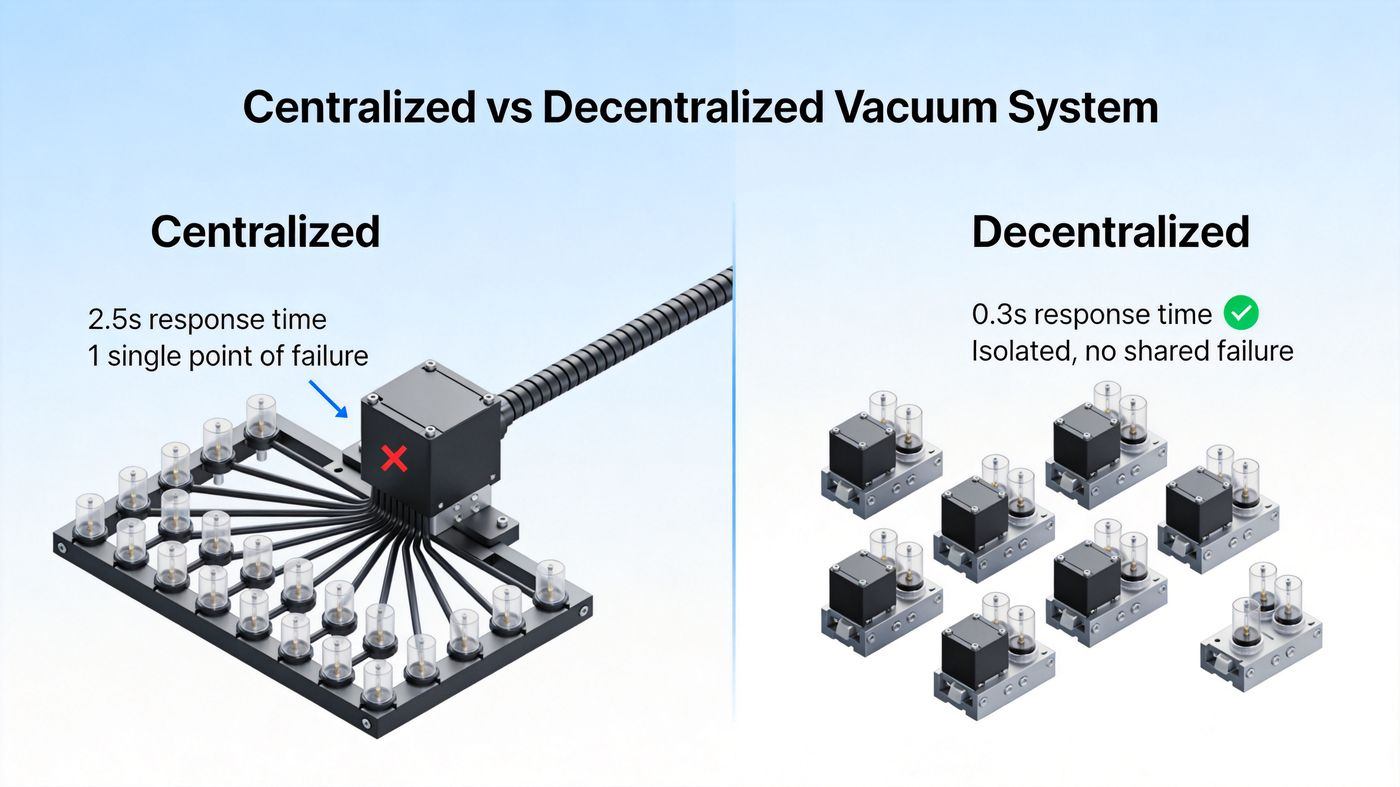
Root cause: Centralized architecture scales badly. With 20 pads and 6 m of branched tubing, the total volume to evacuate balloons to 1.5-2.0 L. A single 1.5 mm nozzle cannot evacuate that volume in under 1.5 s. The line runs at 60% of theoretical speed, and a single leaky fitting takes down the entire gripper.
Fix it: Move to a decentralized architecture. Mount a compact integrated ejector (ejector + valve + filter + silencer + vacuum switch) directly on the gripper, paired with 1-2 pads each. The ejector sits within 100 mm of the pad, so evacuation time is dominated by the pad itself, not the tubing.
Expert Annotation: For multi-pad EOAT, decentralization is almost always the right answer once you exceed 4 pads or 2 m of total tube length. The component cost per station is higher, but cycle time improves 3-5x and a single failed ejector no longer stops the line.
Product examples for decentralized architecture:
VPC VZK Series (integrated ejector + valve + filter + switch + silencer, 0.5-1.5 mm nozzles)
VPC ZK2 Series (similar integrated form factor, widely available globally)
8. Nozzle Keeps Clogging — Replacing Ejectors Every Few Months
Most common in: plants with steel air piping, no coalescing filtration, or older compressors with degraded desiccant.
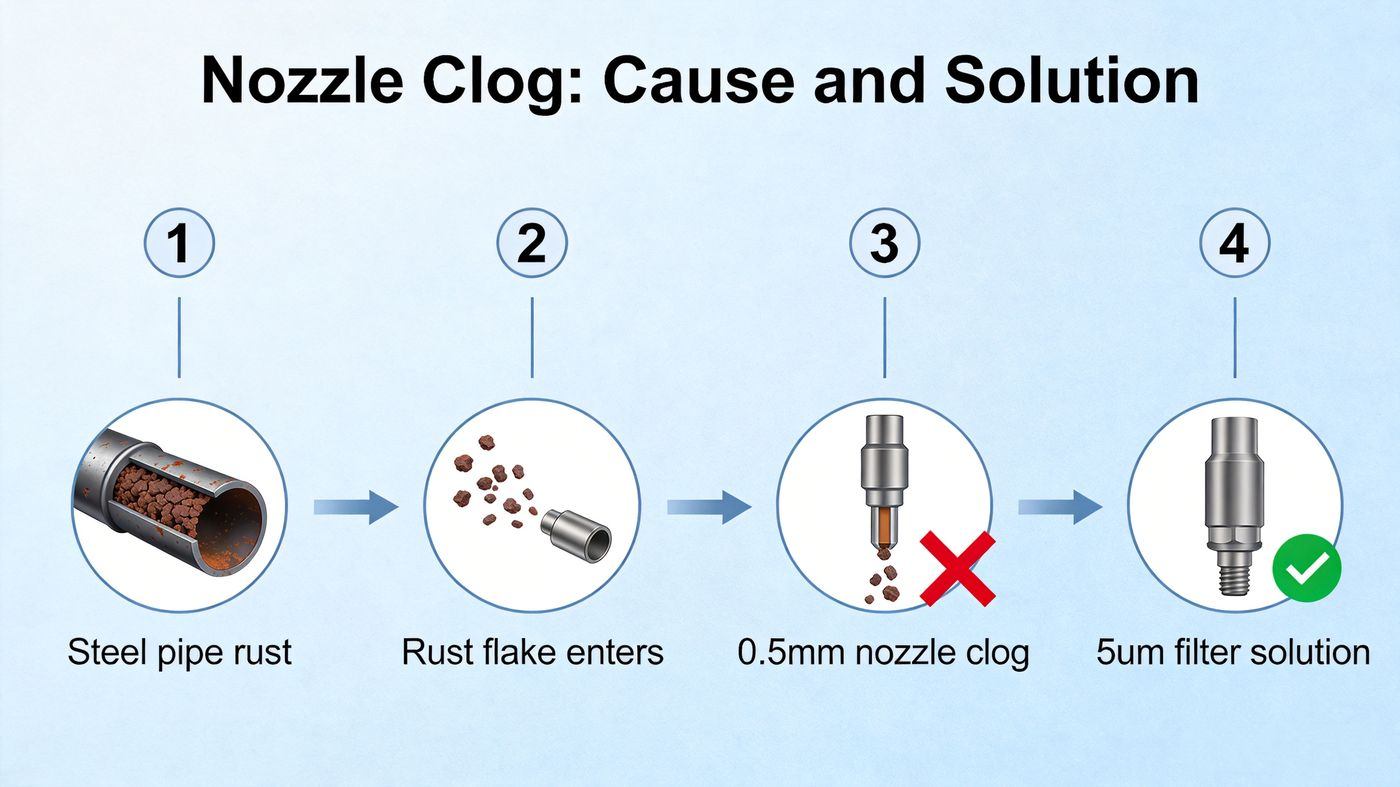
Root cause: The Venturi nozzle throat is 0.5-2.0 mm. A single rust flake from unfiltered steel pipe is enough to partially block it. Compressor oil carryover, water slugs, and desiccant dust are other common contaminants. Once the throat is restricted, vacuum flow drops and the part drops.
Diagnose it: Open a failed ejector and inspect the nozzle under a magnifier. Brown residue = oil. Orange flakes = rust. White crystals = desiccant dust. Black tar = compressor oil breakdown. The color tells you what is missing upstream.
Expert Annotation: For compressed air at the point of use, ISO 8573-1 Class 3 (particulate ≤ 5 µm, oil ≤ 1 mg/m³) is the minimum for reliable pneumatic vacuum ejector operation. Most plant air is Class 5-7. A 5 µm coalescing filter plus a 1 µm particulate filter is the standard solution.
Fix it (in priority order):
① Install a 5 µm coalescing filter upstream of the ejector. Single biggest improvement.
② Add a refrigerated or desiccant air dryer to remove water vapor.
③ Install an auto-drain on the receiver tank and filters.
④ Replace steel air piping with aluminum or stainless if you are in the middle of a plant upgrade.
⑤ Choose ejectors with a nozzle throat of 1.0 mm or larger if you cannot guarantee clean air. The flow penalty is small for most pick-and-place applications.
9. Quick Troubleshooting Checklist
Use this 5-minute checklist before opening any ejector. 80% of vacuum generator problems show up in the first three rows.
| Symptom | First Check | Second Check |
|---|---|---|
| No suction at all | Supply pressure at ejector inlet (0.45 MPa?) | Is the solenoid valve energized? |
| Weak or intermittent suction | Leaks at fittings and vacuum pad | Pad diameter and material compatibility |
| Evacuation too slow | Tubing length and inner diameter | Is the silencer clogged? |
| Noisy operation | Silencer condition | Box-type vs body-ported model |
| Repeated nozzle clogs | Upstream filtration (5 µm or better?) | Piping material (steel vs aluminum) |
| Parts drop during fast motion | Vacuum gauge location (ejector vs pad) | Inline filter or quick-disconnect restriction |
| Won't reach setpoint on cardboard / foam | S-type vs L-type selection | Pad durometer (use soft 30-50 Shore A) |
10. Choosing the Right Vacuum Ejector (Nozzle Diameter + S-type vs L-type)
Two parameters drive 90% of pneumatic vacuum ejector selection. Get these right and the rest is mechanical fit.
Nozzle Diameter Selection
| Nozzle Ø | Max Vacuum | Suction Flow | Typical Pad | Best For |
|---|---|---|---|---|
| 0.5 mm | -90 kPa | 5 L/min | Ø10-20 mm | Small electronic parts, sealed surfaces |
| 0.7 mm | -88 kPa | 12 L/min | Ø20-40 mm | General pick-and-place, most common |
| 1.0 mm | -85 kPa | 24 L/min | Ø30-60 mm | Faster cycles, slightly porous workpieces |
| 1.5 mm (L-type) | -70 kPa | 42 L/min | Ø40-80 mm | Cardboard, foam, wood, large carton |
| 2.0 mm (L-type) | -60 kPa | 68 L/min | Ø60-150 mm | Heavy porous, large-area EOAT |
Reference values at 0.45 MPa supply pressure. Vacuum levels are theoretical maximum; expect 5-15 kPa lower at the pad end due to flow resistance.
S-type vs L-type: when to use which
S-type (suction / high-vacuum): Sealed workpieces, small to medium pads, high holding force per unit area, clean rooms.
L-type (large flow): Porous workpieces, large pads, leakage-tolerant applications, fast release (less residual vacuum).
11. VPC Vacuum Ejectors — Engineered for These Applications
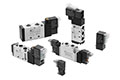
Four product families cover the 8 problems above. The right pick depends on your noise target, decentralization decision, and workpiece type.
ZH Series Box Type Vacuum Generator
Built-in silencer, 0.5-1.5 mm nozzles, 60-65 dB(A) operation. Drop-in replacement for SMC ZH05/ZH07/ZH10 in pick-and-place cells where operator noise is a concern.
Best for: Problems 1, 2, 6 — general-purpose pick-and-place, sound-sensitive stations.
ZH Series Large-Flow Vacuum Ejector (L-Type)
1.5-2.0 mm nozzles, up to 68 L/min suction flow. Designed for porous workpieces where leak rate exceeds the capacity of a standard S-type ejector.
Best for: Problem 5 — cardboard, foam, wood, particle board, fabric.
ZU Series In-Line Vacuum Generator
Compact body-ported ejector for cabinet-mounting with remote silencer. Use when you need high flow in a small footprint, or when the silencer must live outside the work envelope.
Best for: Problem 6 (remote exhaust) and Problem 7 (decentralized clusters).
VZK Series Integrated Vacuum Ejector
All-in-one block: vacuum ejector + solenoid valve + 5 µm filter + silencer + vacuum pressure switch. Mounts directly on the gripper, within 100 mm of the pad. Eliminates 80% of the tubing and fitting failures seen in centralized designs.
Best for: Problems 3, 4, 7, 8 — multi-pad EOAT, high-speed Delta robots, decentralized cells.
For pad selection, VPC stocks NBR (general purpose, oil-resistant), silicone (food-grade and high-temperature), urethane (soft, for irregular surfaces), and FKM/Viton (chemical and high-temperature) in Ø10-150 mm sizes, flat, bellows, and oval geometries.
Still troubleshooting? Tell us your setup.
Share your workpiece material, pad diameter, supply pressure, and cycle time. Our application engineers typically respond within 4 business hours with a sizing and configuration recommendation.
 Request a Free Consultation
 Download the 2026 VPC Vacuum Catalogue (PDF)