Views: 50 Author: Site Editor Publish Time: 2026-07-09 Origin: Site


Official Website for Mexico: https://vpc-pneumatic.mx/
The single most common cause of premature pneumatic component failure isn't cheap parts — it's contaminated, unregulated, or poorly lubricated compressed air. A correctly sized and maintained FRL (Filter-Regulator-Lubricator) unit prevents the vast majority of solenoid valve failures, cylinder seal wear, and vacuum generator clogs that plague automated production lines. Yet in field surveys across industrial maintenance teams, FRL setup errors are the most frequently overlooked root cause.

1. No FRL at All — Or the Wrong Type for Your Application
What goes wrong: A machine builder connects pneumatic valves and pneumatic cylinders directly to the shop air header. Within weeks: rust particles jam solenoid valve spools, water condensate corrodes cylinders internally, and dry O-rings crack without lubrication.
The minimum viable setup for any pneumatic system:
Every machine needs at minimum a filter + regulator (FR unit or AFR).
Lubricator is needed only if your components require lubricated air.
Warning: once you introduce oil mist, all downstream components must be compatible — never mix lubricated and non-lube components on the same branch. SMC and Festo both specify: if switching to non-lube operation, replace all downstream tubing and fittings to remove oil residue.
Filtration grade by application:
| Application | Recommended Filtration | Example |
| General pneumatics (cylinders, valves) | 5 µm (standard) | SMC AF series, Festo FRC-D 5M option |
| Instrumentation / fine control | 0.3–1 µm + coalescing | Precision regulators, proportional valves |
| Food / pharmaceutical | 0.01 µm + activated carbon | Sterile air, cleanroom pneumatics |
| Vacuum generators / ejectors | 5 µm minimum (nozzle protection) | See vacuum troubleshooting guide |
2. FRL Unit Installed Backwards, Sideways, or Too Far from the Machine
What goes wrong:
Backwards flow: Air enters the outlet port. The filter can't separate water, the regulator can't control pressure, and the lubricator drips oil into the regulator instead of downstream. Many units have IN → OUT arrows cast into the body — ignoring these means zero filtration and regulation.
Bowl not pointing down: The filter bowl must face vertically downward (±5° maximum per Festo specification) for condensate to collect and drain. A sideways or inverted filter passes water straight through.
Unit too far from the point of use: Every meter of pipe between the FRL and your valves adds friction loss and pressure drop. For lines over 5–10 meters, install a secondary filter-regulator near the machine, not just at the compressor room.
The fix: Mount the FRL within 3 meters of the machine's main air inlet, vertically, with the bowl down. Leave clearance below the bowl for manual drain operation (at minimum 50 mm). Use the correct mounting bracket — both SMC AC and Festo FRC-D series include dedicated wall/panel brackets.
3. Regulator Set Too High, Too Low, or "Set and Forgotten"
What goes wrong:
Too high: Excess pressure accelerates cylinder seal wear, increases air consumption, and can exceed component pressure ratings. Standard pneumatic cylinders are rated for 1.0 MPa — operating continuously at 0.9 MPa leaves almost no safety margin.
Too low: Below the minimum operating pressure of downstream valves (typically 0.15–0.2 MPa for pilot-operated spool valves), solenoids click but spools don't shift. Cylinders lose force and speed.
"Set and forgotten": Regulator springs fatigue over time. A regulator set to 0.5 MPa two years ago may be delivering 0.35 MPa today. Without a pressure gauge, you'd never know until parts start dropping.
Best practice:
Set working pressure at 0.4–0.6 MPa (4–6 bar) for general pneumatics — this is the sweet spot for most SMC and Festo components.
Always adjust pressure while increasing — turning the knob clockwise to raise pressure prevents the set-point drift that occurs when adjusting downward (per SMC's regulator operating instructions).
Lock the knob after setting. Festo FRCS and SMC AR series both offer lockable knobs.
Check and recalibrate quarterly. A gauge that reads zero when the system is depressurized confirms it's still accurate.
4. Lubricator: Too Much Oil, Wrong Oil, or No Oil on a Lubricated System
What goes wrong:
Too much oil: Excess oil mist coats the inside of tubing, attacks certain seal materials (particularly EPDM), and can carbonize inside solenoid valve pilot passages, causing intermittent sticking that's extremely difficult to diagnose.
Wrong oil: Using standard hydraulic oil or motor oil instead of ISO VG32 turbine oil (Class 1, no additives) — the only lubricant recommended by both SMC and Festo for pneumatic systems. Other oils contain detergents and anti-wear additives that form varnish deposits on spool surfaces.
No oil on a system designed for lubricated air: Non-lube cylinders and valves can run dry — but if the original machine builder designed for lubricated air and you stop the lubricator, seals dry out and fail.
How to set lubricator drip rate correctly:
① Fill with ISO VG32 turbine oil only.
② Release inlet pressure before refilling (AL-series type).
③ Turn adjustment knob toward "+" until a drop appears at the sight dome.
④ Back off ¼ turn — you're looking for 1 drop per 5–10 actuator cycles, not a continuous stream.
⑤ Check consumption daily for the first week; weekly thereafter.
*Field tip: If you can see an oil film on the exhaust silencer of a solenoid valve within a month, the lubricator drip rate is too high.


5. Never Draining the Filter Bowl or Changing the Element
What goes wrong:
A filter bowl that's half full of water isn't filtering — it's feeding water directly into your air lines. Plus, a full bowl means the float-type auto drain (if equipped) is stuck, clogged, or the drain tube is blocked.
Maintenance schedule (minimum):
| Component | Action | Frequency |
| Filter bowl | Drain condensate | Daily (manual drain) / check auto drain function weekly |
| Filter element | Inspect, replace if discolored | Every 3–6 months (or when pressure drop exceeds 0.1 bar across filter) |
| Lubricator bowl | Refill oil | When level drops below 1/3 |
| Regulator gauge | Verify zero and set-point | Quarterly |
Element replacement trigger: If the pressure gauge at the regulator outlet reads 0.1 MPa (1 bar) lower than the gauge at the filter inlet — at the same flow rate — the filter element is clogged and needs replacement. This pressure differential test takes 30 seconds and tells you more than visual inspection.
6. Using a Polycarbonate Bowl in the Wrong Environment
What goes wrong:
Polycarbonate bowls — standard on most SMC AC/AW and Festo FRC-D Mini/Midi units — are chemically vulnerable. Exposure to organic solvents, cutting oils, synthetic compressor oils, thread-locking compounds, or alkaline cleaning agents causes microscopic stress cracks that can lead to catastrophic bowl rupture under pressure.
When to switch to a metal bowl:
The FRL is within 2 meters of a machining center (cutting fluid mist)
The compressor uses synthetic oil
Thread sealant or Loctite is used on nearby fittings
The environment is exposed to UV light (sunlight through a window)
The system is frequently pressurized/depressurized (fatigue cycling)
Both SMC (AC-A series with "2" suffix) and Festo (FRC-D metal guard standard) offer metal bowl options. The cost difference is minimal — switch preemptively if any of the above conditions apply.
FRL Sizing: How to Choose the Right Body Size
| Body Size (SMC / Festo) | Port Size Range | Nominal Flow at 0.7 MPa | Suitable For |
| Mini (AC20 / FRC-Mini) | G1/8–G1/4 | 600–1,200 L/min | Single machine, small assembly cell |
| Midi (AC30–40 / FRC-Midi) | G1/4–G1/2 | 1,500–2,600 L/min | Multi-station line, moderate automation |
| Maxi (AC50–60 / FRC-Maxi) | G1/2–G1 | 6,800–8,700 L/min | Central air prep for large systems |
Sizing rule: Choose the FRL body size so your total air consumption at peak demand is ≤70% of the unit's rated flow (leaving 30% margin for pressure drop across the filter element as it ages).
Prevention Checklist
FRL installed within 3 m of machine inlet, vertically, bowl down
Filtration grade matches application (5 µm minimum for general pneumatics)
Regulator set to 0.4–0.6 MPa, locked, gauge functional
Lubricator filled with ISO VG32 turbine oil only, drip rate 1 drop / 5–10 cycles
Filter bowl drained daily or auto drain functional
Filter element replaced before pressure drop exceeds 0.1 bar
Metal bowl installed if near chemicals, cutting fluids, or synthetic oils
Never mix lubricated and non-lube downstream components on the same branch
VPC Air Preparation Units
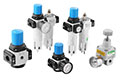
VPC manufactures a complete range of FRL and air preparation components covering all standard industrial applications:
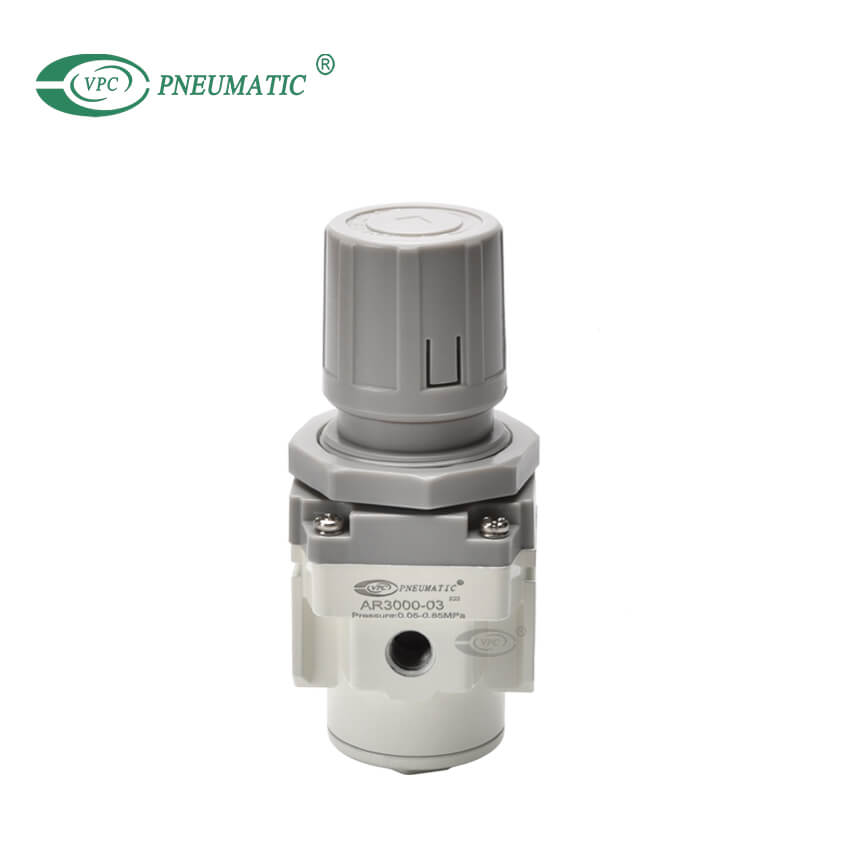
AC Series Air Combination Units (AC20–AC60) — Filter + Regulator + Lubricator in modular assembly. 5 µm filtration, 0.05–0.85 MPa regulation range. G1/8–G1 ports. Matching SMC AC series mounting and port dimensions.
AF Series Filters — 5 µm standard; coalescing and activated carbon options for instrumentation and cleanroom applications.
AR Series Regulators — Relieving type, with and without gauge. Precision regulator options (IR series) for ±0.1% repeatability applications.
AL Series Lubricators — ISO VG32 compatible, adjustable drip rate, sight dome for visual confirmation.
AW Series Filter-Regulators — Combined filtration and regulation in a single compact body. Widely used as machine-mount point-of-use units.
IR Series Precision Regulators — For applications requiring tight pressure control: tension control, force control, pilot regulation.
All units are factory-tested for leak, pressure regulation hysteresis, and flow rate. Every unit ships with dimensional drawings and mounting instructions.
Tell us your port size, required flow rate, and operating environment. We'll recommend the correct FRL configuration. Request a quote.
 Download the VPC Air Preparation Catalog (PDF)



 English